
Flying to Giotto Ch. 3 (The Donbas)

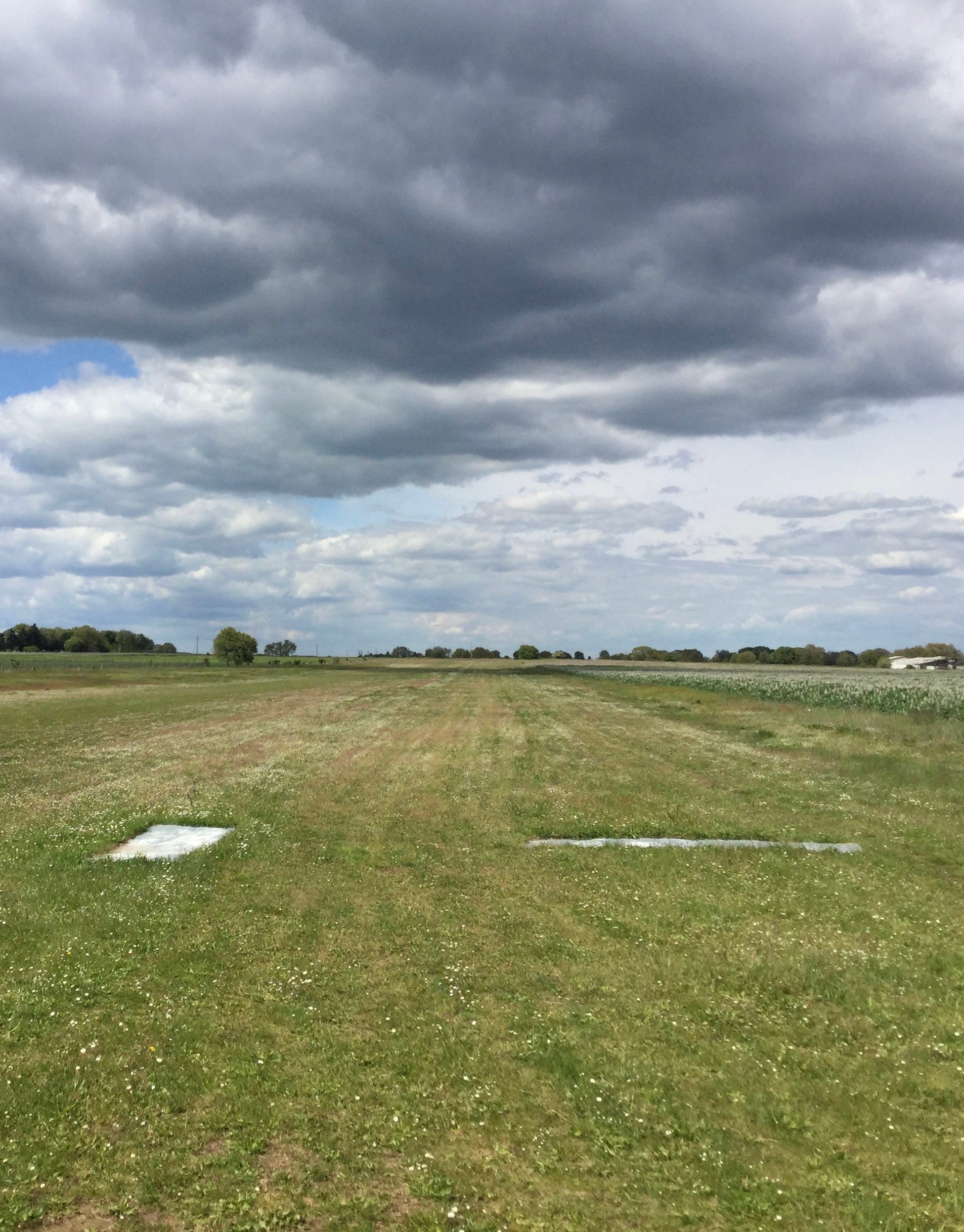
Photo © David Matlock 2026
Return to Chapter 1:
https://davidmatlock1.substack.com/p/flying-to-giotto-ch-1
Return to Chapter 2:
https://davidmatlock1.substack.com/p/flying-to-giotto-ch-2
CHAPTER 3: THE DONBAS
At ten in the morning Alex departs runway 26 of Donetsk Airport and banks north under instructions from air traffic control, crosses a flooded quarry low enough that swimming boys look up and wave, escapes grimy industrial suburbs and enters black earth, copses and villages of wooden homes covered with asbestos-containing corrugated roofing. In twenty minutes he reaches the Seversky Donets River and follows it to the northeast, enjoying the trees, winding watercourse and bumps of the warming day.
The Braviy Gusak aerodrome is next to a lake broken off the river but it’s hard to identify the grass airfield which blends with the land. He spots the red windsock, sees two women waving from the runway and radios ATC that he will be landing at Braviy Gusak, Brave Goose, what a name for the village!
The grass runway looks rough. Alex plants the main gear and keeps his nosewheel off the bumpy ground for a roll before it drops down. He turns off the runway onto a cement apron leading to a Quonset hut with a rusty padlock on a double door and the words ‘BRAVIY GUSAK DOSAAF’ fading off its corrugated side. DOSAAF—the Voluntary Society for the Promotion of the Army, Aviation and Navy—offered flight training to young men and women in the Soviet period. It’s as if he’s been transported fifty years back in time,
Next to the hangar in the shade of mulberry trees, a one-story wooden barracks settles in berry-stained grass and yellow flowers. A green UAZ off-road vehicle is parked on the cracked cement apron. The landing is a blend of familiarity and strangeness—the field like an unkempt spot in the States where you risk a prop strike—but the barracks and sign are from the Soviet world, only back then the paint would have been fresh and the grass maintained with care. Is this the beginning of a trip to buzz a mansion in the Alps? What could it have to do with reaching Anastasia?
Two women, one very old and the other decades younger, watch him taxi to the door of the hangar. He shuts down the engine, opens the canopy, jumps out, and runs his fingers over the propeller edges—grass stains and nicks, but no significant damage. The older woman waves off a bee, removes keys from a leather purse and grasps the rusty padlock on the hangar doors. The young woman walks up to Alex in jeans and a white linen blouse embroidered with flowers, a braid over her shoulder. He had imagined a heavy-set forty year old packing a side arm. What can this girl do to protect him?
The briefing from the PMG Chief of Security in Moscow had been laconic: ‘You’ll be met by an SBU officer named Olga Vlasenko who owns a guest house in the area and will be responsible for your protection.’ Alex knew that the SBU is the Security Service of Ukraine, the successor organization to the Soviet K.G.B., with convoluted ties to Russia’s intelligence services. They had a common parent and senior officers had trained together before the collapse of the Soviet Union. PMG Security left him with a warning: ‘Boris Tseitlin, the current CEO, could be dangerous. When the privatization of RedkoZem is finished you can fly to Italy.’
Nothing else. He was out of the room before he realized he hadn’t asked any questions. He could have returned but had no idea what to ask. So he flew and that part was familiar, especially the bumpy landing strip.
“Welcome to Braviy Gusak, Alexey Nikolaevich! How was the flight?” the young woman asks.
“It was fine, what a lovely airfield!
“Olga Borisovna,” she uses her patronymic and they shake hands.
“I’m Alex, not much older than you,” he hints that she not be so formal.
“Stop chattering with Alexey Nikolaevich and take the windsock down!” the old woman says while she works the lock, avoiding the diminutive of his first name. Olga walks toward the pole by the side of the runway.
“Please let me try,” Alex holds a hand out to the vigorous old lady for the keys. “How might I address you?”
“Magdalena Danylovna,” she hands him the keys. “The lock needs oil. Wait here.” She opens the canvas cover at the rear of the antique UAZ, removes a tin container of oil, and passes it to Alex. The lock resists. “Squirt in more and wait a minute,” she commands.
“It is kind of you to meet me, Magdalena Danylovna.” It seems natural to use formal address with her.
“I learned to fly gliders before the Great Patriotic War at this airfield, so when my granddaughter said she was meeting someone here, I had to come.”
Olga puts the red windsock in the back of the UAZ, then joins them. “What a strange way to arrive!” she says.
Magdalena Danylovna shakes her head in disapproval. Over what? Olga’s reaction is impossible to read. He feels like he’s been parachuted into occupied Europe to partisans horrified by his greenness. He has little idea of his mission. Until the moment of his landing, everything had seemed familiar, the cockpit, the communication with air traffic control, the view from a low-altitude cruise, the good weather. The flying was so automatic that he had been able to think about the disease that has gripped him—‘Who will believe me, if I swear that I have had the plague a year?’—only it wasn’t a year but a couple weeks and the sensation is getting worse. There is no way he can ask his sister whether the conversation with Anastasia has taken place. He is left with the hope she will become his in spite of knowing that’s impossible. Or maybe it’s possible? She had smiled at him when he spoke of Giotto. “Is the small plane part of the operation?” Olga asks. He realizes he has been standing almost frozen with the keys and that his silence has had disconcerted them.
“I plan to fly to Italy when I’m done here.”
“To Italy?” Magdalena Danylovna echoes.
“To look at Giotto’s frescoes,” he adds.
“You’re meeting an agent there?” Olga waves away a bee in front of her nose.
“The owner wants to use this airplane for touring over the summer in Italy so I agreed to ferry it, then PMG asked me to stop here on the way for the privatization of RedkoZem.”
“Who owns the plane?” asks Magdalena Danylovna.
“A banker who flies out of Myachkovo near Moscow.”
“You didn’t crash so he must be reliable.” The old woman shakes her head as if she’s amazed it wasn’t brought down by sabotage.
“He just wants to tour Italy in his plane.”
“After you’re finished here, you’ll go there?” Olga asks.
“Yes, when the RedkoZem privatization is completed.”
“He’s joking with us!” she says to her grandmother.
“No, he’s not joking.” Magdalena Danylovna’s lips press in a grimace.
“The people in our guest house arouse suspicion, Alexey Nikolaevich. I hope they don’t delay you,” Olga uses his patronymic again.
He turns back to the massive lock. They watch him while he attempts to twist the key. It refuses to yield. “I can leave the plane outside,” he suggests.
“Nothing will be left of it if you do,” Magdalena Danylovna says. “Give the keys to Olga Borisovna. She’s good with her hands.” Olga quickly works the lock open. He opens the rust streaked doors silently on their hinges—they’ve been oiled. There’s plenty of room inside beside two dismantled gliders with their wings alongside the fuselages, an orange Wilga tow-plane covered by a thick layer of dust, and a six cylinder engine in pieces.
“We will have someone stay in the barracks while the plane is here, just in case,” the old woman says. “You need to be careful.”
“You are different from what we were expecting,” Olga says to Alex.
“How am I different?”
“We were expecting someone experienced,” Magdalena Danylovna interrupts. It sounds like an insult. He stares at her.
“Babushka!” Olga says sharply. Then she turns to Alex: “My grandmother worked for the Germans in Rivne at the Reichskommissariat while spying for the Soviet Army during World War II.” Rivne is one thousand kilometers to the west and was the location of the administration for occupied Ukraine, Belorussia and Eastern Poland. She must be past ninety and looks great.
The old woman meets his gaze. “The Germans thought my family was reliable because my brother was a Banderite.” Followers of Bandera supported the Germans during the war, and continued as guerilla fighters against the Soviet Union with U.S. and British support until the early 1950s. Her voice is clear and tinkling.
“Is your brother alive?”
“The Germans shot him as a Soviet spy in 1943 even though he wasn’t. It was me. The Gestapo never figured that out. I was in love with a Polish boy hiding in the woods, so I couldn’t take seriously my brother’s Bandera obsession with pure Ukrainian blood.”
“What happened to the Polish boy?” Alex feels as if seventy years have evaporated and it’s World War Two again.
“Murdered in a village where he was hiding.” She could be speaking about something that happened yesterday.
“We now have a young man from Lviv in the guest house. I found a pistol and silencer hidden in his mattress. He likes grandmother because she speaks Ukrainian.” Did World War Two never end? What is this visitor from Lviv doing in Braviy Gusak?
Alex stands frozen staring at Olga. Could his conviction that he will win Anastasia be as crazy as Bandera’s belief in an ethnically pure Ukraine? It’s as if they both hold a strange belief that defies logic. Evidence isn’t required, just action to make it come true.
“We’ll leave your weapons in the hangar,” Magdalena Danylovna says. “Olga will come back for them later. We can’t take the risk of your being searched on the road.”
“I don’t have any weapons.”
“It’s good you’re careful. I did the same when I was working for the Germans. The Gestapo was always snooping, but a German officer said that not having a side arm looked suspicious and gave me a Walther PPK for protection. I still have it.”
“A family relic,” Olga says.
“A Makarov shoots better but the Walther reminds me of my youth,” she says in her young voice.
“Did the officer suspect your role?”
“When he took me for target practice he remarked that my bad shooting was not convincing. I think he understood everything.”
Alex removes the tow bar from the plane, attaches it to the nose wheel, and drags the plane into the hangar, with the women controlling the wing tips for clearance past the entrance.
#
“Guests come from Donetsk or Kharkiv on holiday,” Olga says from the driver’s seat as they pull up to a modern three-story log cabin with picture windows and a large deck overlooking the fifty meter wide Seversky Donetsk River about five kilometers from the aerodrome. Alex is on a hard seat in the back.
“Now the boarding house is full of people interested in the RedkoZem privatization,” Magdalena Danylovna says from the passenger seat.
“Those are beautiful oaks,” Alex points out the window to a hill five hundred meters from the water.
“That’s where your predecessor was knifed to death,” Magdalena Danylovna says, as they exit the UAZ. “He didn’t put up a fight.” She puts her hand on his arm and turns him to face her. “Have the people at PMG met you?” She seems to think it’s impossible that a company as serious as PMG could have sent him on such a mission.
Alex returns the wrinkled gaze. He feels like she is forcing him awake into a world where death comes in the trees.
“Yes. They gave me instructions to pass on any messages I get for them.” As he speaks, Alex notices a man with a beard observing them through an opening in lace curtains in a second floor window.
“Many people dream of action. Do you need it?” Magdalena Danylovna asks.
“Do I need what?”
“Danger,” she says. “It is what has kept me young.”
“I don’t know,” Alex says.
Olga laughs. “You understand you are a target?”
“Why am I a target?”
“To prevent a Russian company from buying RedkoZem. The Americans are working in league with people from Lviv,” Olga says.
“Who is staying in that room?” Alex points at the window, now empty of its bearded face.
“Boris Tseitlin, the chief of RedkoZem. He asked us this morning when you’re arriving.” Olga looks at the window and turns back. “Why?”
“He was watching us.”
“Now I understand,” Magdalena says. “PMG sent him because of his passport. They are daring opponents to kill an American.”
“Or maybe he’s working for the Americans,” Olga says.
“Are you?” Magdalena’s blue eyes are two lakes in the barrens.
“No.” Is he a fool to be so calm?
“He’s not lying,” Magdalena holds his gaze. “Do you know how to shoot?”
“I did skeet shooting in school and target practice with 22 caliber rifles.”
“Have you used a Makarov?” Magdalena asks, switching to the familiar form of ‘you’. Is she warming to him or showing disdain?
“No.”
“Olga will teach you. Don’t count on your passport keeping you alive.”
The two day flight from the Myachkovo Aerodrome near Moscow to Donetsk had relaxed him. It had been hard to believe that he was getting an extra five hundred dollars a day to have such a good time, but sometimes you get lucky. Or maybe it isn’t luck and he doesn’t understand what he has agreed to. He doesn’t sense danger. What he sees are loaded trees with yellow apricots lining both sides of the unpaved road leading to the village of Braviy Gus.
“Are they ripe yet?” He points at the fruit.
“Two more weeks. Once they’re ripe, people come at night and pick them while we’re sleeping.” Olga folds her arms. “You’ll be gone before they’re ready to eat.”
The apricots hanging by the side of the dusty road seem real; Anastasia’s smile was real. She has probably made her trip to Bolzano, spoken to his sister, and made her way back to Rogozov’s arms in the Alps. That’s real. But the warnings of Olga and her grandmother feel like something he is watching in his sleep. They can’t be real.
#
Alex’s room on the first floor looks out to a willow draping the water next to the dock. He drops his backpack and small suitcase by the bed and returns to reception where Olga is waiting for him with a black gym bag looking heavy on her shoulder. She asks for his phone and locks it in a safe. Then they drive to the aerodrome, park on the cement apron by the hangar, and walk down an overgrown path to the bank of the lake he flew over in the plane. The muddy green surface is dotted with white water lilies. A stone shed on the bank is missing its roof and door.
“We’ll use the wall as a barrier,” Olga points at the shed. She removes a Makarov pistol from the gym bag. “The guy from Lviv with weapons under his mattress served a sentence for armed robbery in the late 1980’s; he’s now a hit man for the far right, name Jaroslaw Voznyuk. He met with both a member of parliament and a Croatian war criminal, Radomir Harambasic, in Kyiv before coming here,” She shows him how to insert the magazine and hands the pistol to Alex.
“What did they talk about?”
“We don’t know. What’s worse is that the Croatian visited a CIA safehouse before the meeting with Voznyuk.” She looks too young to be talking of such matters.
“What does this have to do with me?”
“The member of parliament said in public that he would use violence to prevent the sale of RedkoZem to a Russian company. You’re a candidate for assassination.”
“The CIA would never collaborate with such people,” Alex shrugs. Either she’s testing him to see if he passes on false information or she’s a believer in conspiracy theories. He’s met the CIA colleagues of his sister and none of them are crazy or unprincipled.
Olga points at the pistol in his hand “This is the same model Voznyuk is hiding. The effective range is fifty meters, but in your case, open fire inside ten or you will miss.”
“I don’t want to shoot anyone.”
“You’ll change your mind when they come for you. Let’s see how you do at ten meters.” A fit man with gray stubble pushes through branches on the overgrown path. They exchange greetings.
“All quiet so far,” he says. “May I take the UAZik to the store to buy groceries?” Olga hands him the car keys and he leaves.
Against the limestone wall she sets up cardboard with the silhouette of a man drawn in chalk, and shows him how to flick off the safety.
“Keep your finger off the trigger until you’re ready to shoot.” She steps back. “Fire at the center of his chest until the magazine is empty.” Two of the eight shots are outside the outline. “Extract the magazine as I showed you,” she hands him a second case full of bullets. “This time, aim at the head.” They spend the next hour kneeling, standing, sitting, working on grip and posture, dismantling the pistol, filling the magazine, reloading by feel.
“Either you can’t shoot or you’re a good actor,” Olga says. He realizes they’ve slipped into the familiar form of address with each other.
“Just like your grandmother?”
“I don’t understand why PMG sent you.” She looks grave. “There’s not enough time to teach you how to move through a doorway or clear a room, but at least you know how to hold the weapon if you have warning.”
“Why didn’t they shoot Linkov?”
“Probably noise. People did hear a cry in the afternoon coming from the woods, but it was only in the evening the body was found by a neighbor’s dog, who brought his owner to the scene.”
“How does murdering Linkov help them? I could understand if it were Rogozov, but this man was insignificant.”
“It’s a warning. They’ll go higher if need be. They might want to make it look like a fight between Moscow and Donetsk, but the local mafia had nothing to do with it. Yanukovich made clear that they should back off if they can’t come up with the money. That means Moscow should win.”
“I don’t understand. Who killed Linkov?”
“The Americans.”
“Not the Donetsk mafia, not that Galician from Lviv?”
“The Galician is working for the Americans.”
“Why would the Americans care? Rogozov wants to sell rare earth elements both to Europe and the US.”
Olga shakes her head as if she can’t believe what she’s hearing. “It’s not a good sign that Voznyuk came straight here after the meeting with Radomir Harambasic ”
“How do you know that?”
“I was told.”
“By whom.”
“By someone in Kyiv who knows.” She points at the bullet-riddled cardboard targets with chalk silhouettes. “Please gather those up while I make coffee. There’s a kitchen in the barracks.”
It’s hot and the sound of crickets grows with the advance of afternoon. He picks up the cardboard targets, floppy with holes, pushes back branches on the overgrown path and traipses through high yellowing grass to the open door of the wooden barracks. There he leans the cardboard against the wall, enters the barracks, feels an arm around his waist, and is tripped to the floor. Judo. Olga sits on top of him with the Makarov in hand.
“That’s not the way to enter a room,” she says. “Your passport looks genuine; I examined it when we registered you. Is it real?”
“Yes.”
“What are you doing here?”
“Why don’t you ask the Chief Financial Officer of PMG?”
“Are you working for American intelligence?” She tickles his throat with the barrel.
“Do you conduct all such conversations at gunpoint?” He doesn’t feel fear; it’s comfortable lying on the floor looking past her at a ceiling of discolored white plaster. The safety is on.
“I need coffee,” she stands to a whistling tea kettle. “There’s only Nescafe instant. Do you take yours with sugar?”
“Black, no sugar.” He rises. The walls are whitewashed plaster. Light comes through the open door and two small windows looking toward the grass runway. The walls are covered with photographs of gliders, pilots, aerial shots, and crowds watching shows from days when the aerodrome was active. Gagarin, autographed and dated September 12, 1963, stands on the apron with two young men in overalls. Olga gestures for him to sit at a table with four wooden chairs. She wipes the plastic tablecloth printed with sunflowers, serves him coffee along with pastries, and sits across from him, holding a white porcelain mug in her hand.
She puts the mug down and slides the Makarov across the table to him. “Now it’s your turn to ask me questions.”
He ignores the weapon. “What are you doing feeding an American spy?””
“I don’t think you are. You’re being treated cruelly.”
“I was told you’re an SBU officer.”
“I have nothing to hide.” She pops a piece of pastry into her mouth. The gesture feels intimate.
“And you cooperate with the Russians?”
“Of course, but we don’t talk about it because of domestic politics.”
“Why are you admitting this to me?” he asks.
“I’m trying to figure out why you were sent. You obviously have no clue.”
“Do you prefer Ukraine or Russia?”
“I haven’t had to choose.”
“Which side would you pick in a war?”
“Both are right; both are wrong. It shouldn’t be difficult to keep Ukraine whole but outsiders are pulling us apart. I don’t know what I’ll do if I have to choose.”
“The instructions to protect me came from which side?”
“From both.” She rises. “I hear the watchman arriving back from the store. It’s time to go. I have to prepare dinner for the guests.” Her reserve is gone and replaced by pity. It’s almost as if she’s looking at a man she expects to die.
If you’ve gotten this far, let me know what you think, even if it’s critical!
So far so good! Looking forward to new installments))