
FLYING TO GIOTTO Ch. 1
ALEX MOROZOV

FLYING TO GIOTTO is about a man whose loss of patriotism erases his moral map and forces him to make decisions in a world of violence with only conscience for a guide.
Summary and Table of Contents:
https://davidmatlock1.substack.com/p/flying-to-giotto-chapters
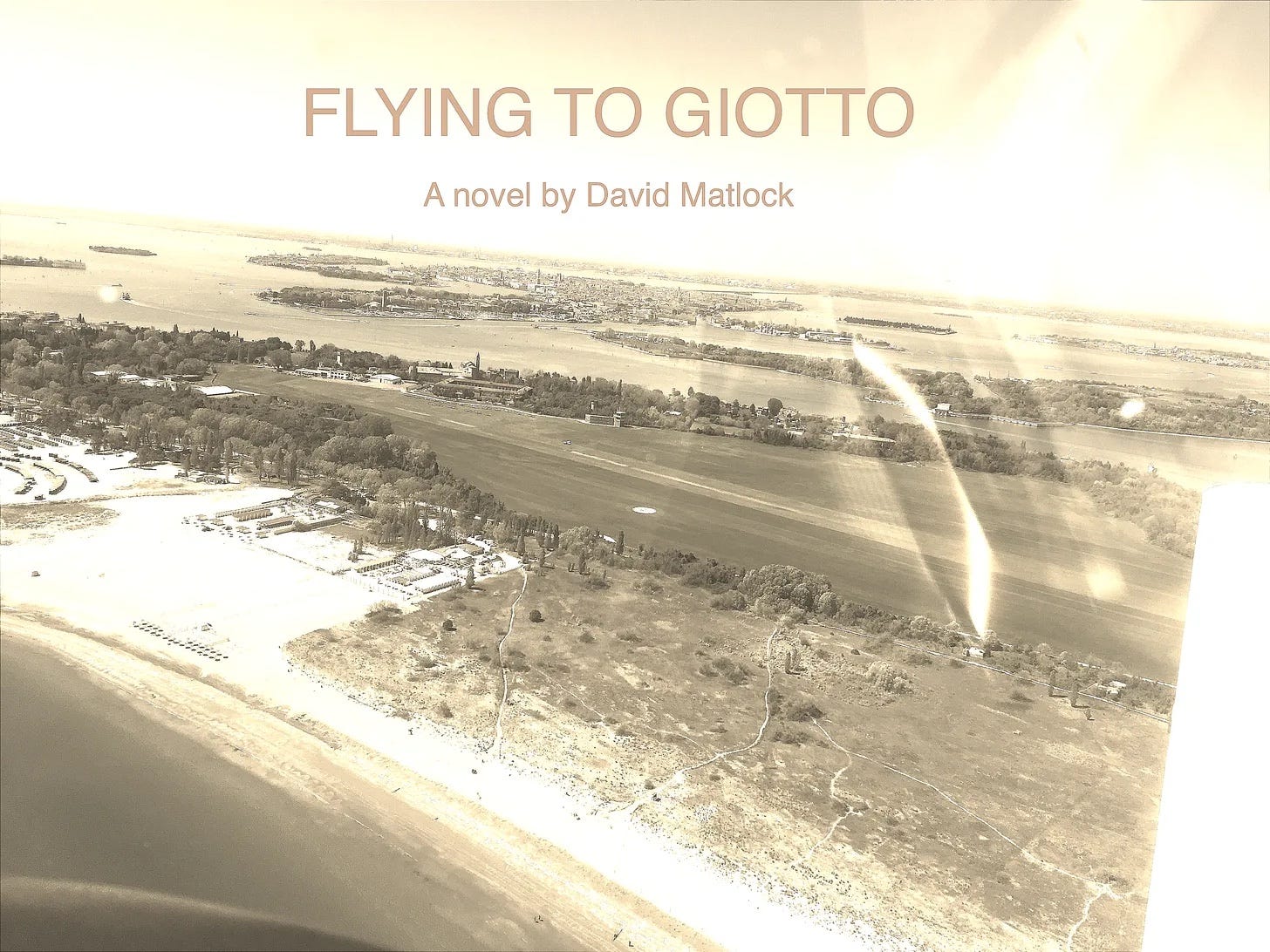
Chapter One: Alex Morozov
Alex’s salary covers the rent in Moscow, barely, only because the apartment hasn’t been renovated in years. At least the walls are whitewashed clean and the floor’s herringbone oak parquet has weathered well. A windowed door opens onto a crumbling balcony with a view of birches and parked cars in the courtyard.
On his knees Alex traces a route in pencil over charts marked with the location of radio beacons used by aviators before the time of navigation software. The maps on the floor are decades out of date, but their scale lets him see his journey in one glance. The direct route leads to the Adriatic coast, but his left hand places a ruler at a different angle from the one he planned and his right hand draws first one line, then another until it reaches the mountainous border with Italy and relaxes. ‘Go however you like from here to Perugia…’ his hand seems to say. The plane isn’t powerful enough to overfly the Alps, so he’d have to wind through passes to get to Italy. Why go that way instead of the direct route to the coastline of Yugoslavia (a country that no longer exists), which he could follow west to Venice, and then descend to Perugia?
He forces himself to draw the sensible route via Yugoslavia and puts the pencil down, but the first, rash line through the mountains has more appeal. It would pass a chalet that Alex has read about in an architectural magazine which belongs to Stepan Rogozov. Alex knows from office gossip that Anastasia will be arriving there in a week.
‘It can’t continue, let’s pretend it never happened,’ were her words a week ago in a deserted office café.
None of this is a good reason to fly an underpowered plane through the Alps to buzz a mansion because she will be there. Lunacy. What does he have to offer her? Why the impulse to pursue? Her past acquiescence made little sense—he’s rational enough to perceive that—but still believes their union is inevitable. A parallel world with its own rules of physics will dictate an outcome that makes no logical sense.
Alex’s iPhone lights up; he stands on the maps in his socks, picks up the phone from a marble top table, and sees a message from Anastasia: ‘I know it’s Sunday but can we speak?’
‘Sure, I’m free. Call any time,’ he fingers automatically.
A moment later the phone chimes. Her voice is quiet and slow. “Sorry to bother you but could we meet outside for a few minutes?”
“You’re welcome to come by my apartment.” Did he say that?
“Let’s meet by the statue of Griboyedov. I can be there in five minutes if you’re free.”
The birth of galaxies, microbial life, the extinction of the dinosaurs, the crimes of homo sapiens, all led to the thin pencil line on the map. Enough sense remains in the narcotic state for him to realize his reaction makes no sense for he hardly knows her—but her call is a vindication.
“Okay, see you there!” he answers, frozen in place. There’s no escaping the disease. There’s no good reason for it but it’s there.
“Just one thing! Are you still on the line?” Her words are rapid.
“Still here.”
“Leave your phone at home,” she slows the words back into her relaxed contralto.
“Leave my phone at home?”
“We’ll find each other.”
“Okay.” Alex lowers his phone and pads off the maps. He changes into grey dress pants and a white linen shirt with a low collar and button front. The shirttail is hemmed straight and he leaves it out. The loafers will do.
#
The walk through the boulevard park, about a hundred yards wide, separated from the car traffic on both sides by trees and wrought iron railings, feels like the beginning of an adventure. Earth footpaths were recently replaced with brick and granite, making the space less dusty in the summer. The silhouette of Griboyedov draped like a Roman emperor against a blue sky is visible from a distance—five minutes have passed and she’s probably there. He senses that the wrought iron, lindens and beds of red and yellow pansies are not real, that there is a shadowy landscape hiding these appearances, and that Anastasia has beckoned him into an erotic jungle of cries and slinking predators.
Her head is turned to read the bas relief scenes from Griboyedov’s verse play at the base of the monument. She’s in jeans, dark brown hair collected in a ponytail. A top reveals the good tone of her shoulders and biceps and a Vuitton handbag over her shoulder creates a look of prosperity. She turns to him and he bumps her nose on the way to kissing her cheek. She ignores the kiss, scans their surroundings, then looks him up and down. He realizes she’s making sure he’s not carrying a telephone. She touches his arm to lead him back the way he came down the central pathway, and that sends intoxicant to his brain, but even in the haze of delight he feels her reserve.
“Thanks for coming so quickly,” Anastasia says as if she’s talking to a man she barely knows.
“I was happy to hear from you.” Alex falls in with her slow pace. She rolls on her feet in a way that makes each step soft, catlike.
She speaks as quietly as a whisper, but without whispering: “I want to speak to your sister.”
“I see.” So this meeting is not a renewal of romance. She pauses in their walk and turns him with two hands to face her. How does she know about his sister, Vera, who works for the CIA as an analyst? Not in operations and it’s not a covert position, but it’s still not something you talk about.
Anastasia continues in a quiet voice. “I’m going fast so there’s no time to set up surveillance. I’m leaving for Austria tomorrow and can cross the border to buy a phone in Bolzano. Could you tell your sister that she’ll get a call from an Italian friend?”
“From an Italian friend?”
“Don’t mention me. Just say an Italian friend will contact her. You can say the person’s name is Dante. I’ll use a burner phone with an Italian number.”
“Is it safe for me to call my sister from here?”
Anastasia nods yes. “Just be casual. Mention that an Italian friend will call her. Make up some story that your sister will understand is not true. Surveillance won’t be able to trace it to me.”
“Okay, I’ll do that for you.” He feels hypnotised.
“Give me her number in the morning on a piece of paper.” She smiles but it doesn’t extend to her eyes. She guides him to a free bench and gestures for him to sit but continues standing herself. His inebriation at her call and touch has been replaced by focus on his task. She may be using him, but at least she has need of him. That’s better than nothing. What would she say if she knew he wants to fly over the house in the Alps? Then he remembers he has his own request.
“I was going to ask permission at work to leave for a week. I was asked to ferry a plane to Italy. Once I’m there I’d like to spend a couple days in Assisi looking at Giotto’s frescoes.”
“Giotto!” She’s not looking at him but scanning the area. “Polina might mind. Just make sure that she has no objections—she’s going to invite you to breakfast—ask her then.” Anastasia folds her arms and looks down at him. “If anyone noticed, say we met by chance and that you took the opportunity to ask for permission for your trip.” She suddenly smiles—this time it extends to her eyes. “Giotto! I envy you.”
“What does Polina want to discuss?” It feels strange referring to the mighty Chief Financial Officer of PMG by her first name.
“Ukraine. PMG has something for you to do there.”
“Ukraine?”
“Polina will tell you. Don’t mention that I want to talk to your sister. I’ll call her Friday.”
“Understood.”
“Wait here for a few minutes and observe if anything strange happens as I leave.” She turns and walks back toward the Griboyedov monument. He follows her narrow hips with his gaze to the Constructivist pavilion with slender columns that is the entrance of the subway and notices nothing out of the ordinary. What a strange request to speak to his sister. A bed of tulips by his bench; a toddler on a scooter; the sound of the fountain to the right; even the sunlight—all seem unreal. What is real is that she has put herself in his power by asking for something illicit.
#
The email to Alex’s older sister, Vera Morozov, suggesting they ‘catch up’ by phone is dated Tuesday, June 11, 2013 at 14:33, which makes it 07:33 in the Virginia suburb of Falls Church where she lives. Vera answers by email immediately—’Hi Alex, we can speak now before I leave for work, or this evening, but that might be late for you.’ Good weather and kids’ voices stream in through the balcony window. He dials her number.
His sister is delighted to hear from him. Mom and Dad are fine. She spent the weekend with them at their house in Cold Spring Harbor on Long Island. “I hope everything’s all right. Do you need me to send money?”
“No, I just wanted to catch up.”
“On my end things are OK, no romance though,” she laughs.
“Remember when we visited Italy together the summer after I graduated?” Silence on her end. There was no such visit. “We met a girl there in the North who called herself Dante.”
“Yeah, I remember her vaguely.” Except for the pause, Vera’s voice has given nothing away.
“She wants to give you a call.” Alex’s voice breaks into a falsetto.
“That’s cool. You been flying?”
“I got a ferry job to Perugia—I’ll be starting end of the week!” His voice is back to normal.
“Did Dante say when she might call?”
“End of the week, like Friday.”
“Okay, I gotta leave for the office. Talk soon!”
It’s done. His sister will wait for a call from Anastasia who is more than kisses and his cries in her arms, the song of a Siren.
#
Alex recalls a dinner at home when he was five years old. The adults were discussing an Idiot with the name Myshkin—and Alex thought they were talking about a mouse because you could translate the name as Mouse-kin. Later he discovered his grandfather believed they were descended from the model for Prince Myshkin. Their ancestor never forgave his friend, Fyodor Mikhailovich Dostoyevsky, for the mockery of his fainting spells or the claim he was an idiot.
“Did the mouse get married in the end?” Alex had asked. His grandfather had liked the question enough to write about it in his diary.
“He wanted to, but couldn’t,” Alex remembers grandfather’s answer. He and grandmother lived nearby in a single story house with a big chimney on the shore of Long Island Sound. Speaking Russian was the rule at the dinner table.
Usually grandfather was silent and grandmother Maria would chastise him: “Your grandson is the copy of you. Can’t you see that life continues?”
They died within a week of each other when Alex was ten. After the funeral, Alex watched his father unlock a cupboard in his Grandfather’s walnut faced study. Hardbound diaries filled narrow shelves. They were packed tight, almost as if grandfather died when he ran out of space. Alex helped his father pack them into a steamer trunk which was moved to the attic of his parent’s house.
“Has anyone read grandfather’s diaries?” Alex asked over a decade later during his graduation from NYU with a degree in Russian literature.
“Some truths are best left buried,” father answered.
“Do you mind if I read them?”
“Why not? He always said, ‘These diaries are for my grandchildren.’”
Alex knew that he had fled Petrograd and crossed the front line during the White Army offensive in 1919 but didn’t suspect that he was miserable in America. He had been in love with a woman and never forgot her. ‘I would been destroyed but died a man,’ he wrote.
Russia in the diaries was birches, wet leaves, a thick wall of spruce in the November rain, the Summer Garden, and Vera. It was canals and neoclassical facades, the Admiralty spire, red flags and going hungry. Even falling apart it was still Russia. Grandfather blamed the opacity of matter on America, as if a different location could rip the veil so that teeming fire underlying reality appeared. As an aerospace engineer, he felt that the United States had peaked in 1903 with the discovery of fight and had a special loathing for large parking lots and the suburbs.
Alex spent the inheritance left by his grandfather on flying lessons, got his instructor’s license and taught for a pittance. Gratitude drew thoughts back to the diaries. Was anything left of the country his grandfather missed? One day he gave notice.
“Where are you going?” his colleagues at the Long Island flight school asked.
“To Russia.”
“That sounds cool,” they said. His buddies brought vodka to the farewell party.
When his Dad asked him why he was moving to Moscow, Alex answered, “I want to find out whether grandfather’s Russia is real.” The excitement of flying had worn off in aerodrome circuits and the banger landings of students. He sensed his grandfather approved.
If you’ve read this far, I’d love to hear your comments, even if critical!
Here’s the Link to Chapter Two:
A compelling setup here! Curious to see where Alex’s flight to Italy -- and his moral compass -- take him next.
Welcome to the House of Chapters #14